1. Software & AI: Real Risk, Over-simplified Conclusions
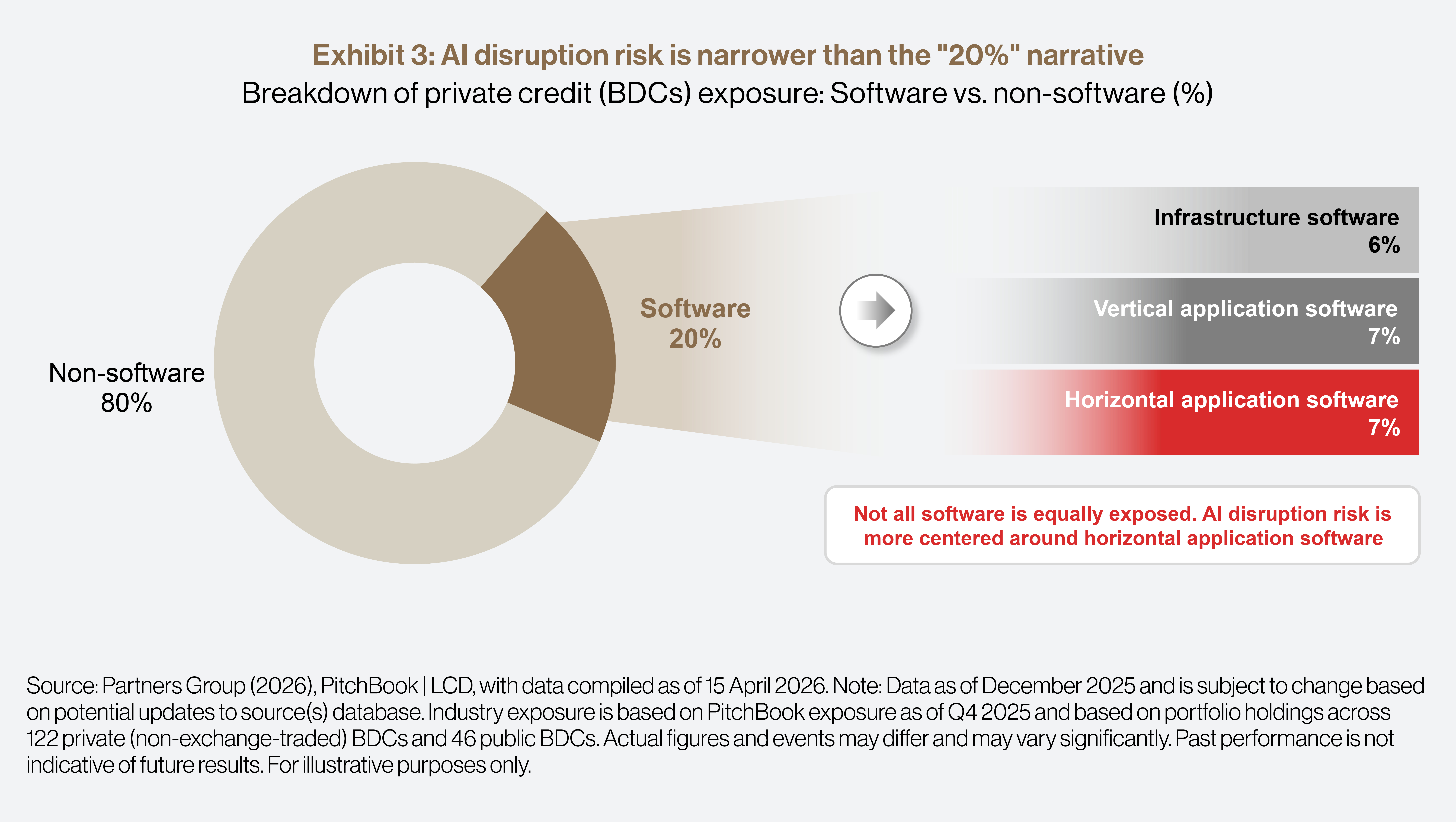
The AI ecosystem has made significant advancements in recent quarters, calling into question the durability of software business models. Software represents roughly 20% of the total U.S. direct lending market5, or closer to 30-35% when including adjacent industries6. Exposure varies significantly by region, structure, and product type, with European direct lenders generally maintaining lower – though still meaningful – exposure of around 10-15%7.
The concern is real. AI product releases are accelerating, capabilities are compounding, and workflows historically handled by standalone SaaS applications are increasingly being automated. Many software loans over the past decade were underwritten on annual recurring revenue (ARR) multiples against seat-based B2B SaaS businesses with sticky revenues – but often limited profitability. If AI efficiencies reduce the number of seats a company needs, the unit economics break down – and with that, revenue durability and terminal value assumptions underpinning these loans come under pressure.
Therefore, some generic, seat-based SaaS businesses will struggle, defaults will likely rise, and there will be winners and losers. But the conclusions drawn are too simplistic in our view for three key reasons:
I. Not all software is equally exposed. Incumbents with strong moats, proprietary data, AI-enabled workflows, and exposure to regulated or mission-critical end markets – where accuracy, compliance, and complexity matter – are better positioned to sustain value and drive efficiency gains. These are lower risk businesses and typically found in infrastructure and vertical application software. By contrast, more vulnerable software tends to be rules-based, repetitive, and often tied to functions like customer service or project management. This exposure largely sits within horizontal application software, which accounts for around 35% of total software exposure within the U.S. direct lending market8. This implies a more modest at-risk exposure of just 7% – well below the 20% headline figure9.
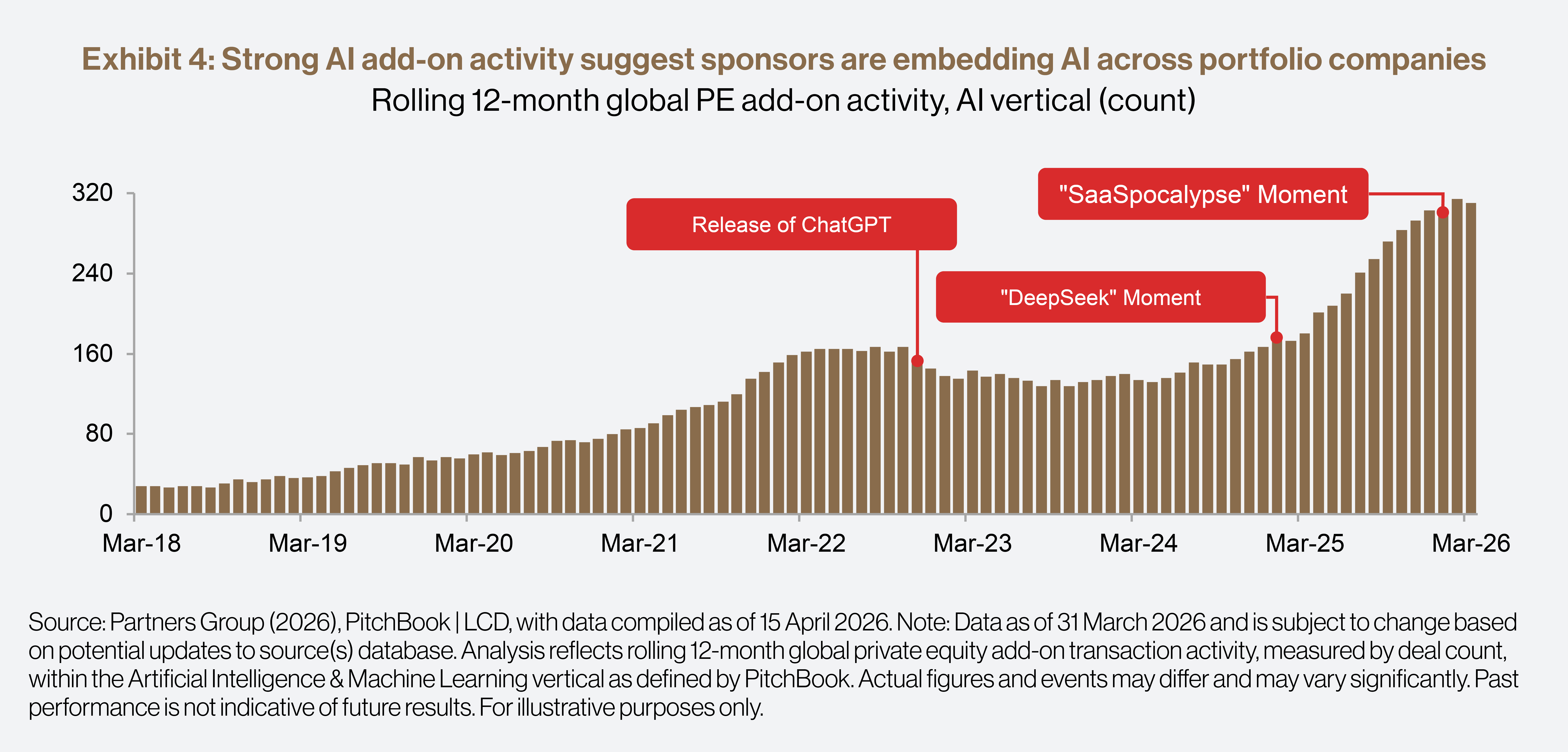
II. Private equity sponsors are actively adapting to the AI transition by embedding AI across their portfolio companies to drive efficiencies, enhance growth and adapt business models. AI-focused add-on activity is running near record highs10 signaling that sponsors are leaning into AI – not stepping back. Private credit managers are also aligned with these sponsors, many of whom have navigated prior disruption cycles and have both the operational playbooks and the vested interest to drive this transition.
III. AI can be a friend, not always a foe to software. In practice, AI is being embedded into existing software ecosystems rather than displacing them. As both Anthropic and Nvidia’s Jensen Huang have noted, AI is often augmenting software, not replacing it – which can effectively increase its addressable market rather than compressing it outright11.
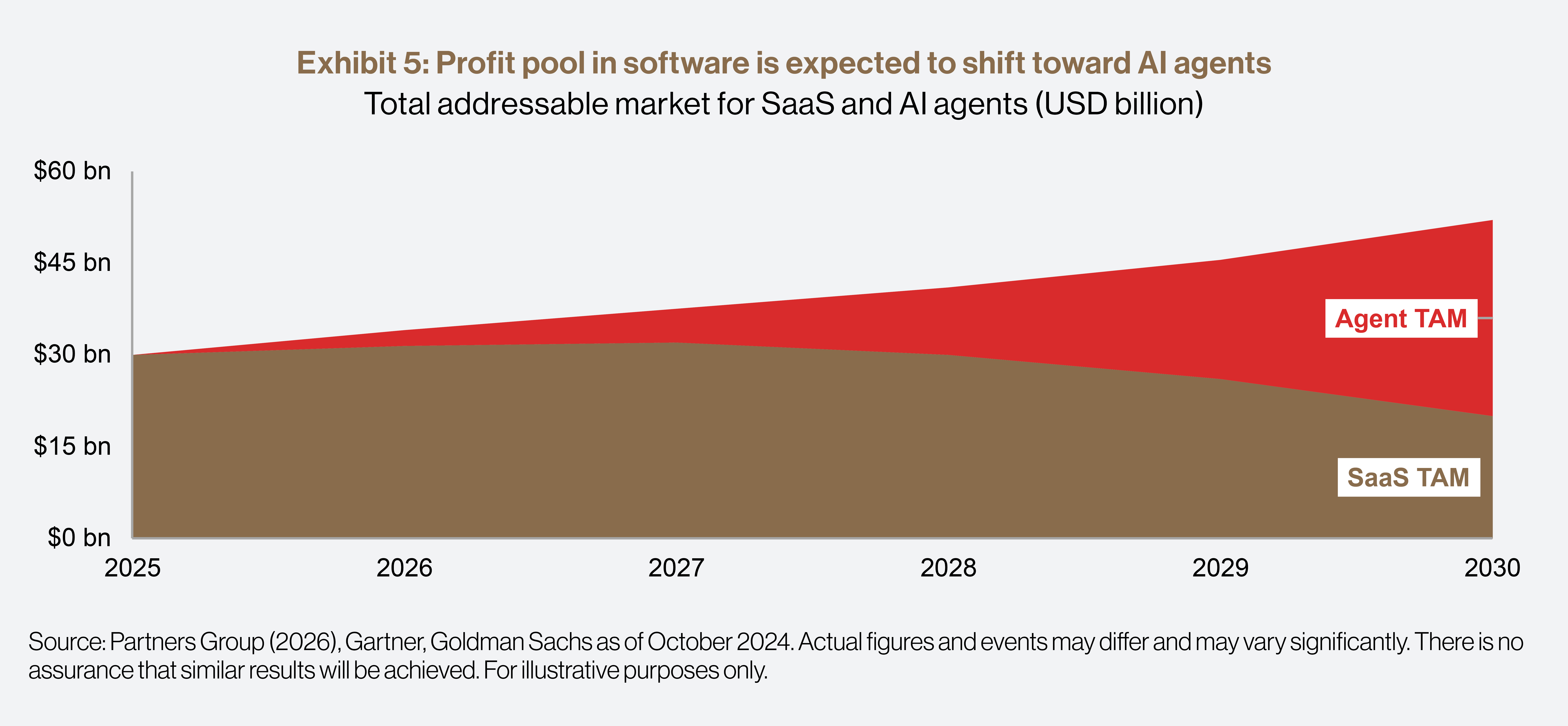
This is not to say that disruption isn’t happening. AI‑driven change is real and will create winners and losers, pushing private credit toward greater bifurcation and dispersion. But a meaningful share of software exposure remains more resilient than headlines suggest for the three reasons outlined above.
2. Refinancing: A Timing and Selectivity Issue
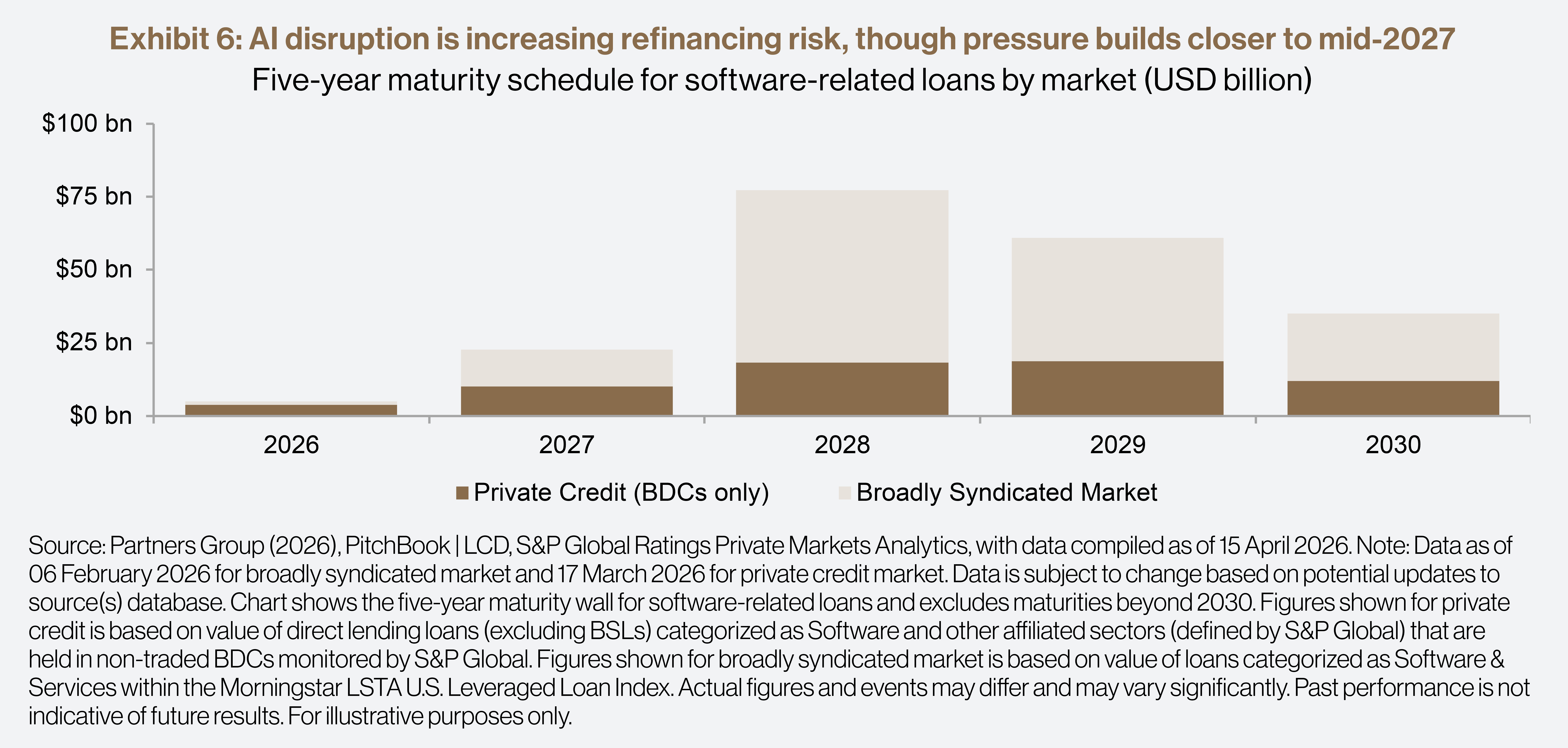
Software concerns have also spilled over into worries around an impending maturity wall and refinancing abilities. Nearly 50% of software loans maturing through 2030 (or c. 35% of all software loans outstanding) come due by 2028 – USD 30 billion12 in directly originated loans and USD 75 billion13 in leveraged loans. This makes refinancing an area to watch, but timing matters here.
Refinancing discussions typically begin 12-18 months ahead of maturity, with execution no later than six months prior. With most maturities concentrated in mid-to-late 2028, the bulk of refinancing pressure is pushed into mid-2027, providing a meaningful buffer. This window allows sponsors time to adapt portfolio companies' operating models – including AI-driven improvements – while giving lenders flexibility to structure solutions that protect downside risks.
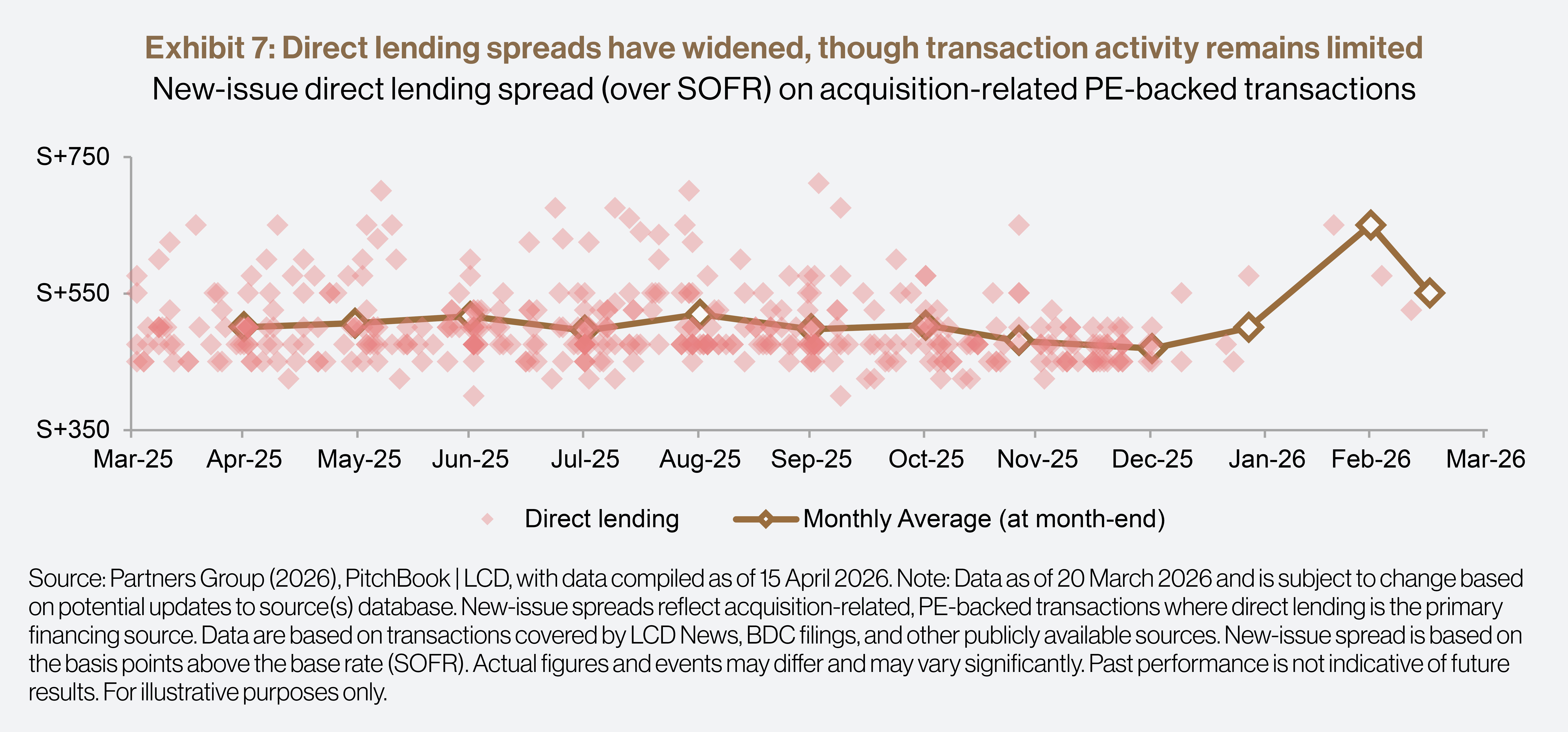
Refinancing will not be frictionless, though. Lenders are already underwriting more conservatively – shifting in some cases from ARR‑ to EBITDA‑based frameworks for software – and demanding wider spreads to compensate for uncertainty. Despite limited transactions activity in recent months, new-issue direct lending spreads are already around 100bps wider, and up to 150bps wider for software, although this is also attributable to broader shifts in credit markets14.
The main risk lies in lender appetite. As maturities approach, weaker borrowers may face higher costs or tighter access to capital. This is likely the primary channel through which defaults could move higher in private credit. Even so, direct lenders remain better positioned than syndicated markets, given their ability to avoid liability management dynamics.
3. Valuations: A Matter of Consistency, Not Fundamentals
Valuation concerns have resurfaced, particularly around the consistency of marks across managers, transparency of methodologies, and stale marks. This has contributed to a perception that private credit portfolios may not fully reflect fair value or underlying risk.
While these concerns are understandable, there are important nuances. Most private credit funds – namely BDCs – rely on third-party valuation firms and a “mark-to-model” framework, where fair value is derived from assumptions around discount rates, borrower fundamentals, sponsor behavior, and recovery expectations, among other inputs.
Importantly, valuation firms assess loans on a periodic basis and assign marks as of a specific date – typically quarter-end or month-end – with results published by managers weeks later. Laws in place explicitly prohibit these firms from valuing assets based on speculative future outcomes or what might happen next. Forward-looking risks can be incorporated only to the extent they are already observable or priced by the market. This means reported marks can quickly become stale in fast-moving environments.
Variation in marks across managers is also driven by several factors, including differences in third-party valuation providers, differences in underlying modeling assumptions, valuation methodologies (range-based vs. point estimate), and the fact that not every loan was originated at the same cost or at the same time. All of these factors can reasonably produce a 5-15 point range in marks across otherwise similar portfolios, particularly for more stressed loans.
That said, we understand the complexities and how this can create the perception of misalignment. However, in our view, this is primarily a transparency and timing issue, not a fundamental credit story. Improved disclosure and more frequent marking should help narrow the gap between perception and reality over time.
4. Redemptions: A Feature, Not a Flaw
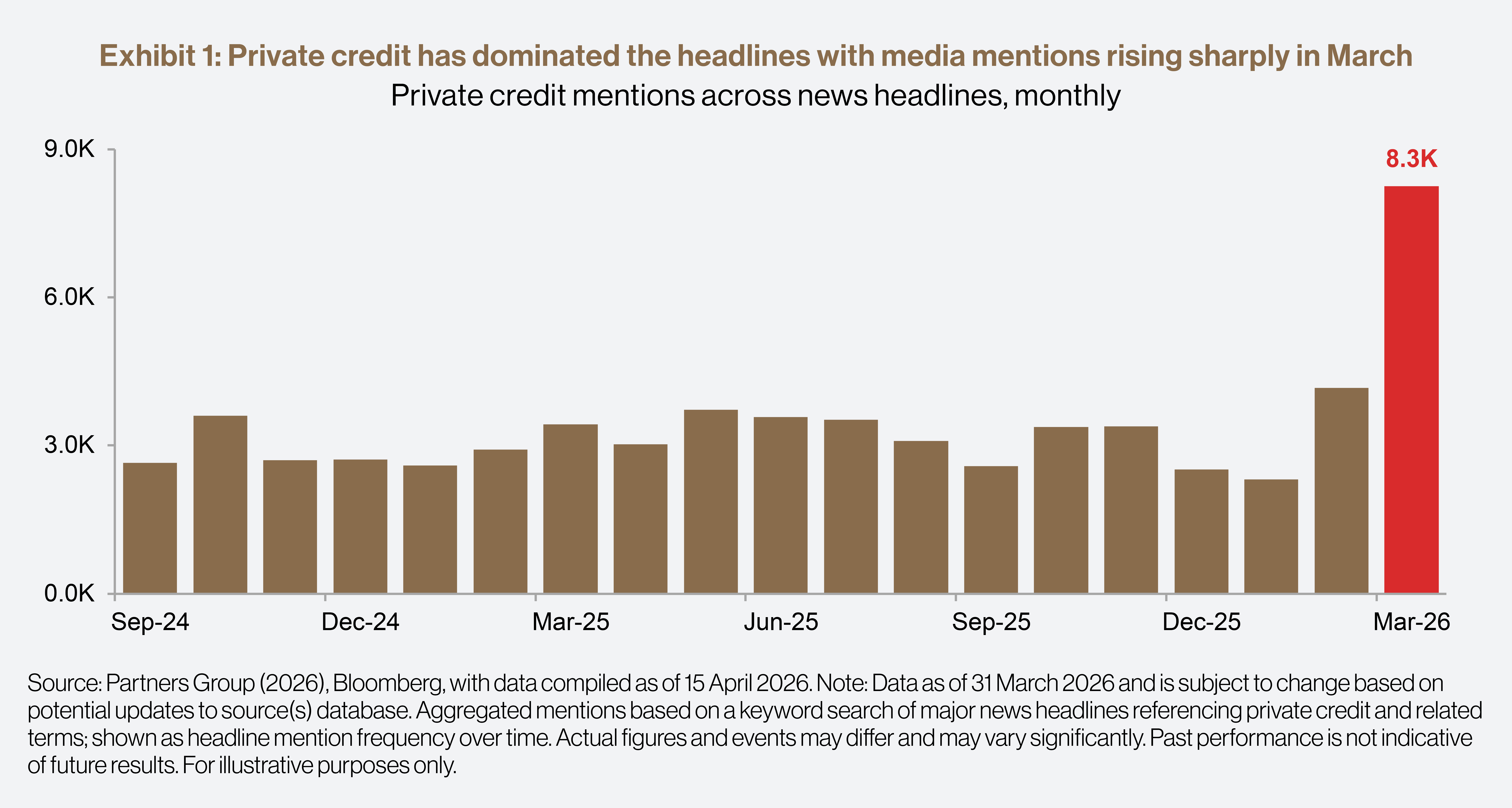
Negative headlines have driven a sharp rise in redemption activity, with Q1 2026 requests nearly five times above the prior four-quarter average15. This has been largely sentiment-driven and concentrated in wealth-oriented vehicles (19% of U.S. private credit market16), with pressure amplified by several funds enforcing their pre-stated redemption caps. Institutional capital, by contrast, has remained stable and in some cases increased as market dislocations and wider spreads have created more attractive entry points.
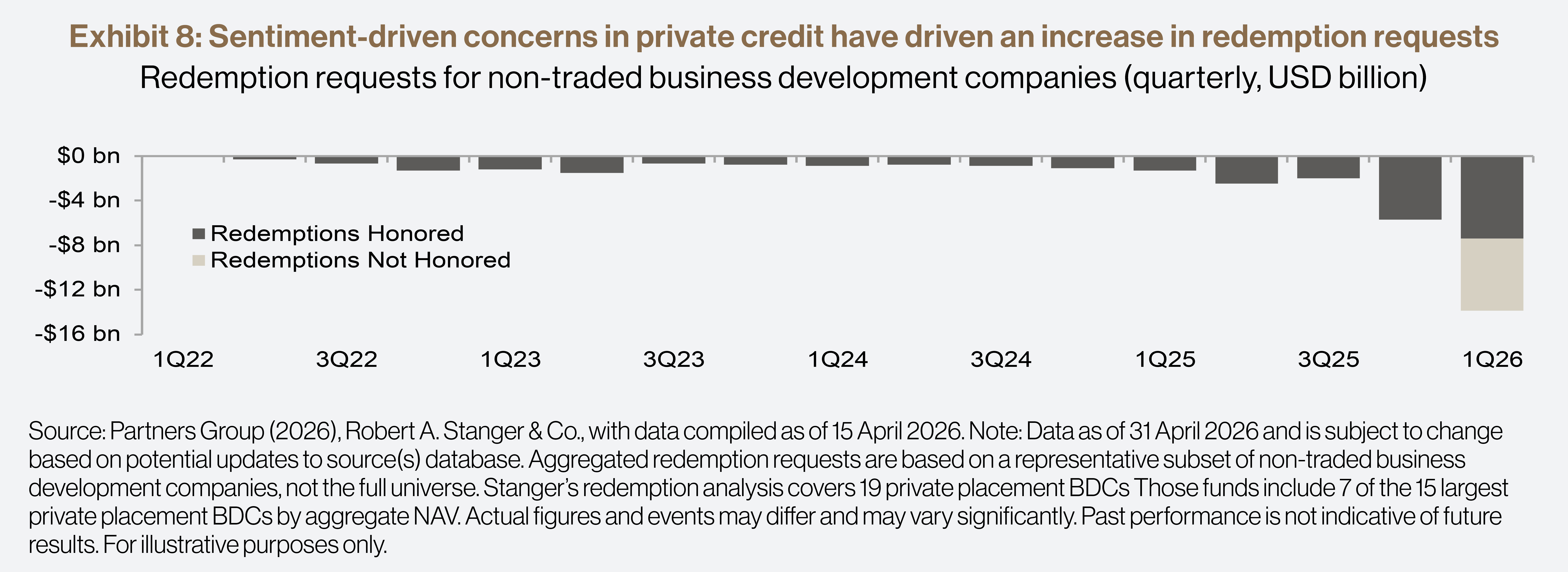
Crucially, redemption caps are a feature, not a flaw. They are designed to align investor liquidity with the long‑term nature of private markets and to avoid forced sales of illiquid assets during periods of volatility or thin market liquidity. What we are seeing today reflects managers acting as fiduciaries, operating within pre-stated limits – not a sign of asset quality problems or liquidity stress.
This is not a blanket “all clear.” Some funds will remain under pressure, but overall liquidity remains meaningful. Most vehicles can meet redemptions at stated limits for at least the next 4-5 quarters, supported by multiple levers, including loan turnover of around 25-30% annually, liquidity sleeves of 10-15% in cash and liquid credit, and access to debt and bank credit lines17.
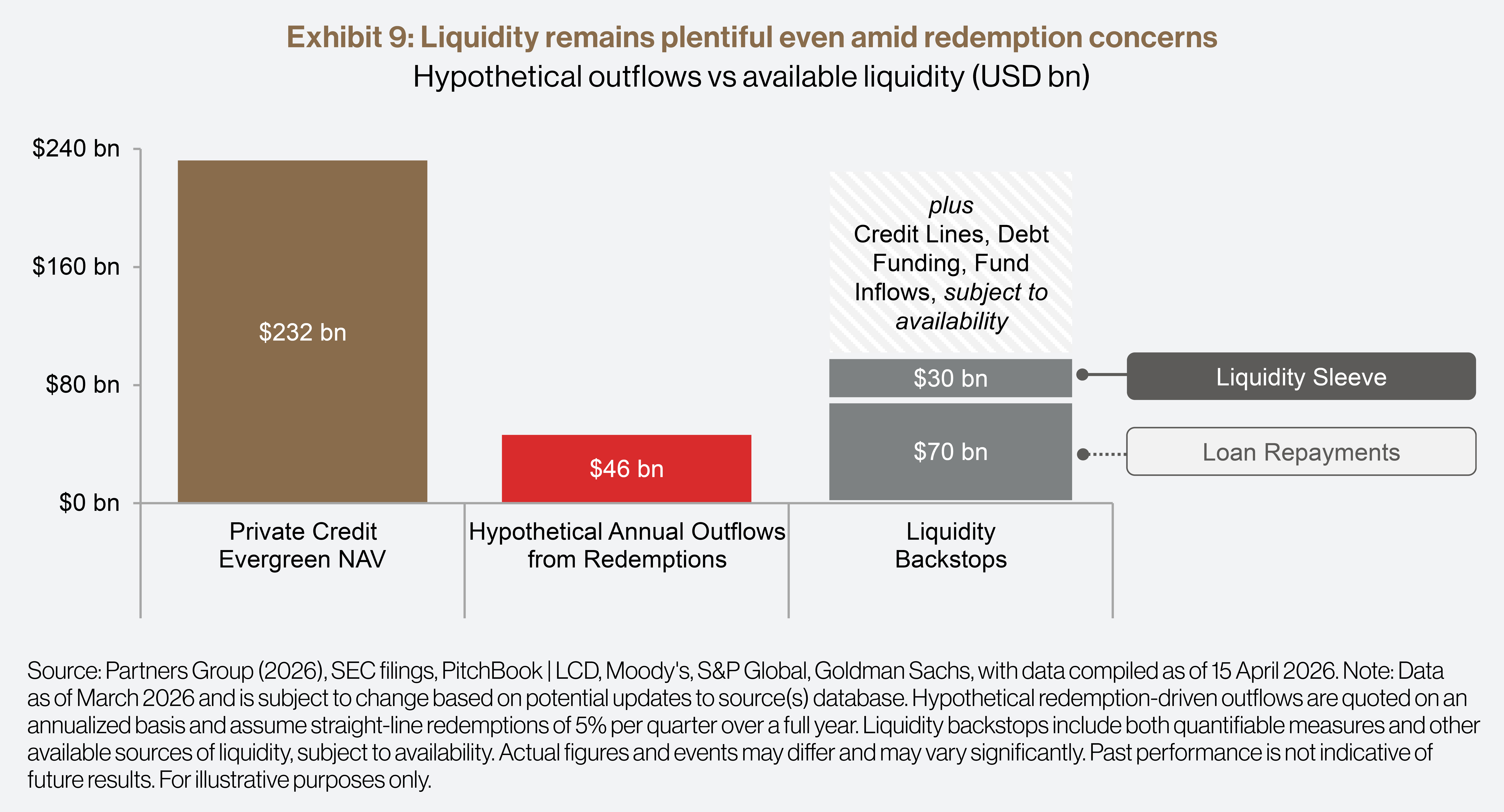
Even if redemptions persist, systemic risk is limited. Bank exposure to private credit is modest – about 4% of large U.S. bank loan books18 versus nearly 40% for mortgages heading into the GFC19 – and conservatively structured at usually 50% advance rates. Losses would require both material collateral declines and weak recoveries. For context, impairing bank lending to private credit would require losses well in excess of GFC levels – which we view as unlikely.