The election results are in and they are indisputable – it's a blue sweep. In addition to Democrats securing Congress, Democratic governors will lead a majority of U.S. states for the first time since 2010.1 With a blue sweep in hand, divided government should constrain more significant policy shifts at the federal level, providing some welcome relief for broader markets.
However, one pocket of the market isn't celebrating: data center operators, neoclouds, and semiconductor stocks, which all fell c. 4-8%2 the day after the election, amid concerns that the data center buildout will slow. Those concerns are understandable. Several of the winning gubernatorial candidates campaigned on more restrictive data center policies, while a Democratic-controlled Congress is likely to scrutinize the buildout more closely.
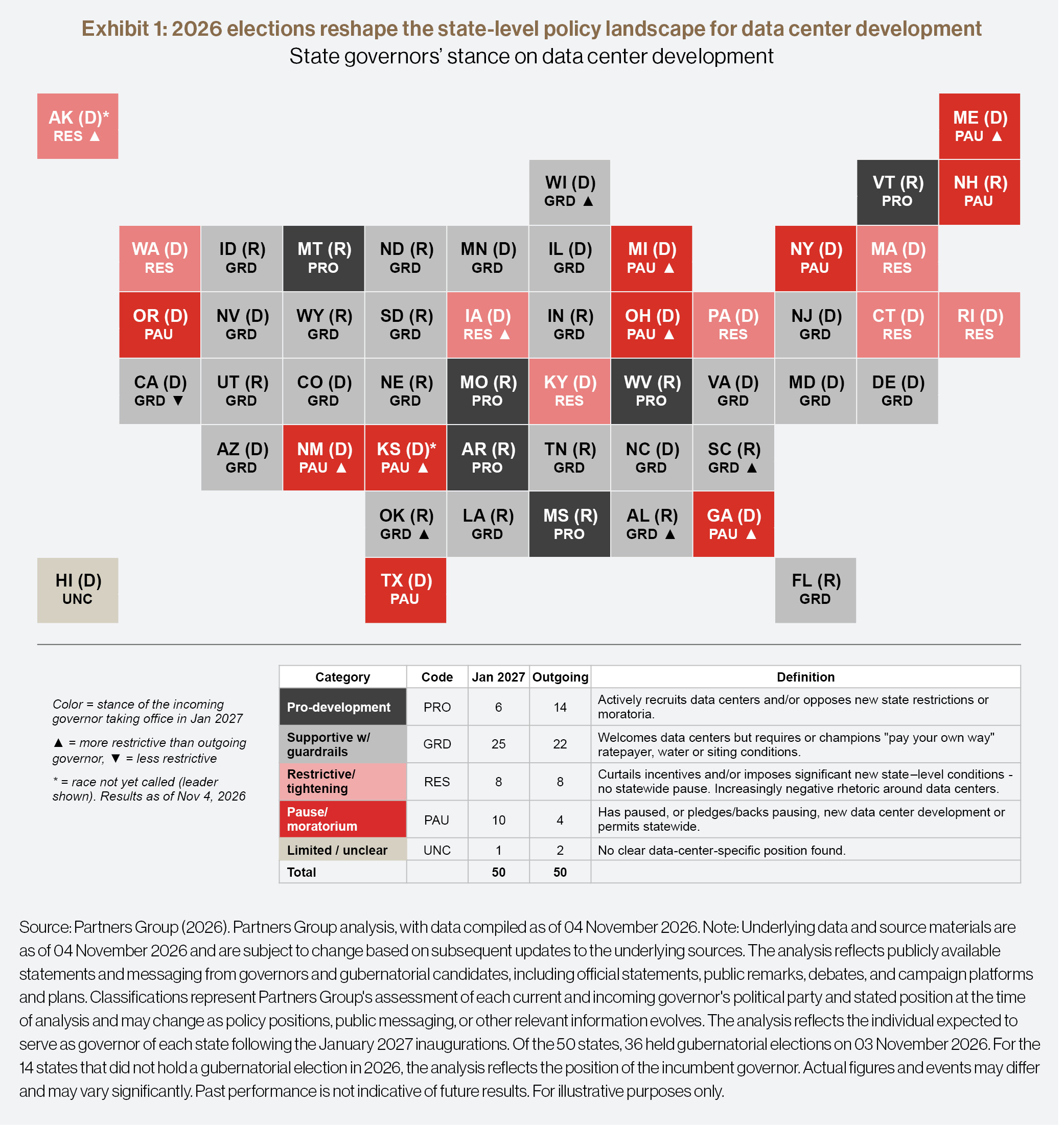
However, we think the market is reading the implications too bluntly. The election results create a more difficult development environment in certain states, but that does not mean the U.S. data center buildout suddenly stops. Rather, we think the bigger implications are around where capacity gets built, how quickly projects move through the pipeline, and which projects ultimately make it to completion.
Partners Group's view is therefore two-fold: First, the election results are more likely to change where and how data centers get built in the near term, rather than whether they get built, because demand for AI compute remains robust. Second, a more restrictive development environment will likely weed out speculative projects, constrain future supply and increase the scarcity premium on capacity that is already powered, permitted and leased.
Where and how, not whether
The most consequential development is that several states that have been at the forefront of the data center buildout – Texas, Georgia, and Ohio – elected governors and state officials who campaigned on more restrictive development policies. Together these states account for c. 37% – or roughly 110 GW – of the announced U.S. data center capacity pipeline through 2030.3
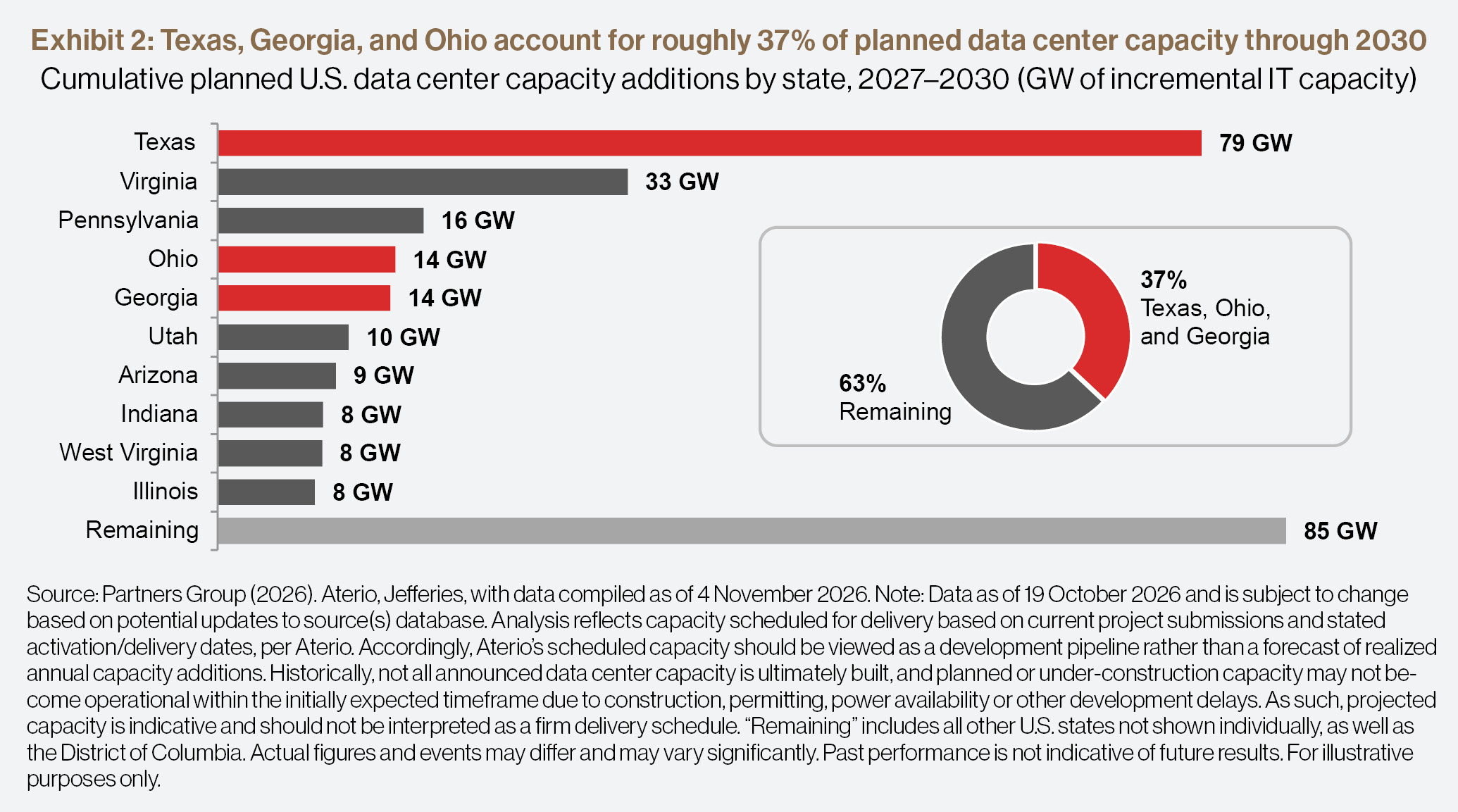
This leaves a sizable share of planned development now exposed to a changing political backdrop. State and local governments have meaningful influence over permitting, utility regulation, infrastructure cost allocation and tax incentives. So, if campaign proposals ultimately translate into policy, projects not yet under construction in these states could face longer development timelines, higher costs, and more challenging economics. Growing public unease over AI and data center expansion could further erode support for new projects. Together, these pressures could widen the gap between projects already underway and those still seeking approvals, power and financing.
Texas is the focal point, with c. 79 GW4 of announced and planned capacity additions through 2030. Governor-elect Gina Hinojosa campaigned on a moratorium on new data center development and has criticized the existing permitting audit and pause initiated by the administration of outgoing Governor Greg Abbott. Georgia is also worth watching, given the potential for changes to utility infrastructure cost allocation and equipment sales-tax exemptions. Ohio, Iowa and Kansas face similar questions as newly elected officials revisit tax incentives and development policies.
But higher development friction in these states does not mean the equivalent amount of U.S. data center development disappears – some of it likely shifts. Development, particularly for data centers not yet under construction, may shift away from contested states and toward jurisdictions with a more constructive regulatory backdrop. Importantly, there are alternatives. Roughly 60%5 of states remain supportive of data center investment, even if subject to additional regulation. States such as Louisiana, Oklahoma, North Dakota and Wyoming are emerging as viable alternatives, alongside states like Nevada, Arizona, and Virginia where support for data centers has historically been robust.6
The fiscal benefits should also remain a powerful counterweight to more restrictive policies. For many communities, the prospect of a sizeable new tax base can be transformative, helping fund infrastructure, schools and hospitals, or alleviate the property-tax burden on residents. And in markets where data centers already represent a substantial portion of the local tax base, the debate is likely to be more nuanced than simply whether to allow further development. Instead, the focus may increasingly shift toward where projects are built, how infrastructure upgrade costs are shared, and what benefits accrue to the surrounding community.
Still, the shift will not be seamless. Relocating development requires securing new sites, power, transmission, fiber, permits and utility agreements. The likely outcome is therefore a reshuffling of the pipeline. Some projects will migrate toward more constructive jurisdictions, some will be pushed out, and some earlier-stage or speculative projects will ultimately be canceled.
Importantly, the U.S. data center footprint is going to keep expanding, especially given that demand for data center capacity from frontier labs and hyperscalers is still immense and continuing to grow. But geographic mix, timing and probability of delivery across the existing pipeline will change.
Scarcity premium for powered, permitted, leased data centers goes up
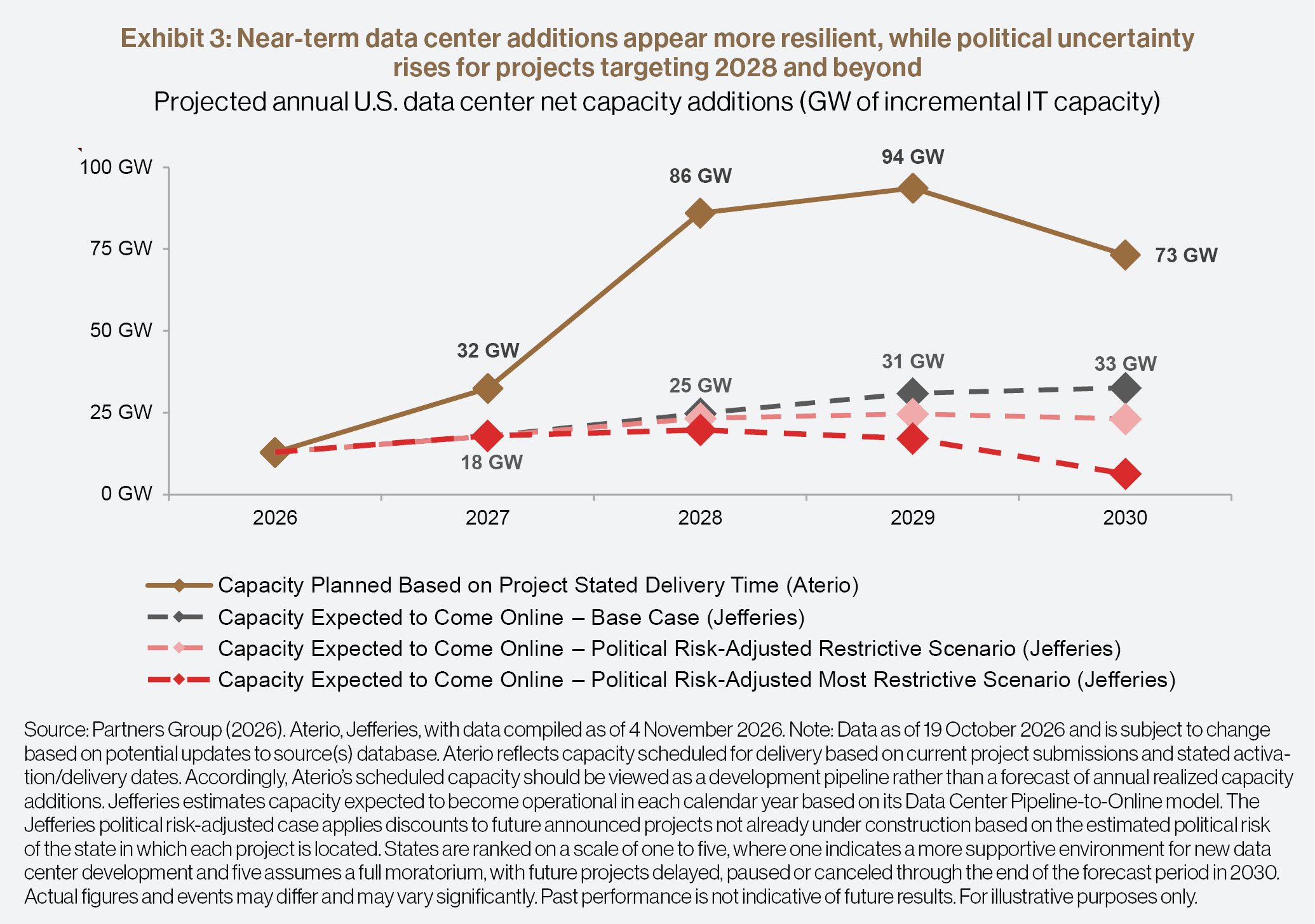
U.S. operating data center capacity totaled c. 50 GW7 at the end of 2025 and an incremental c. 12-18 GW8 is expected to come online by end of 2026. Despite emerging state-level headwinds, 2027 capacity additions also look resilient – roughly 80% of the c. 32 GW9 planned to come online in 2027 is already under construction, making those additions less vulnerable to changes in the political environment.
However, the greater uncertainty surrounds projects targeting 2028 and beyond, which face pressure from two directions. Permitting delays, higher development costs and potential policy changes could push out timelines and make certain projects uneconomical. At the same time, efficiency gains and shifts in computing models could reduce the amount of incremental data center capacity required to meet future compute demand, weakening the economics of some planned projects even if they clear regulatory hurdles.
At the same time, efficiency gains and shifts in computing models could weigh on future compute prices, leaving some planned facilities financially unviable even if they clear the regulatory hurdles.
As a result, actual capacity additions will likely fall short of previously announced plans, and cancellations of pipeline projects will continue to pile up. These are likely to be concentrated in speculative, unpowered, incentive-dependent projects in contested states.
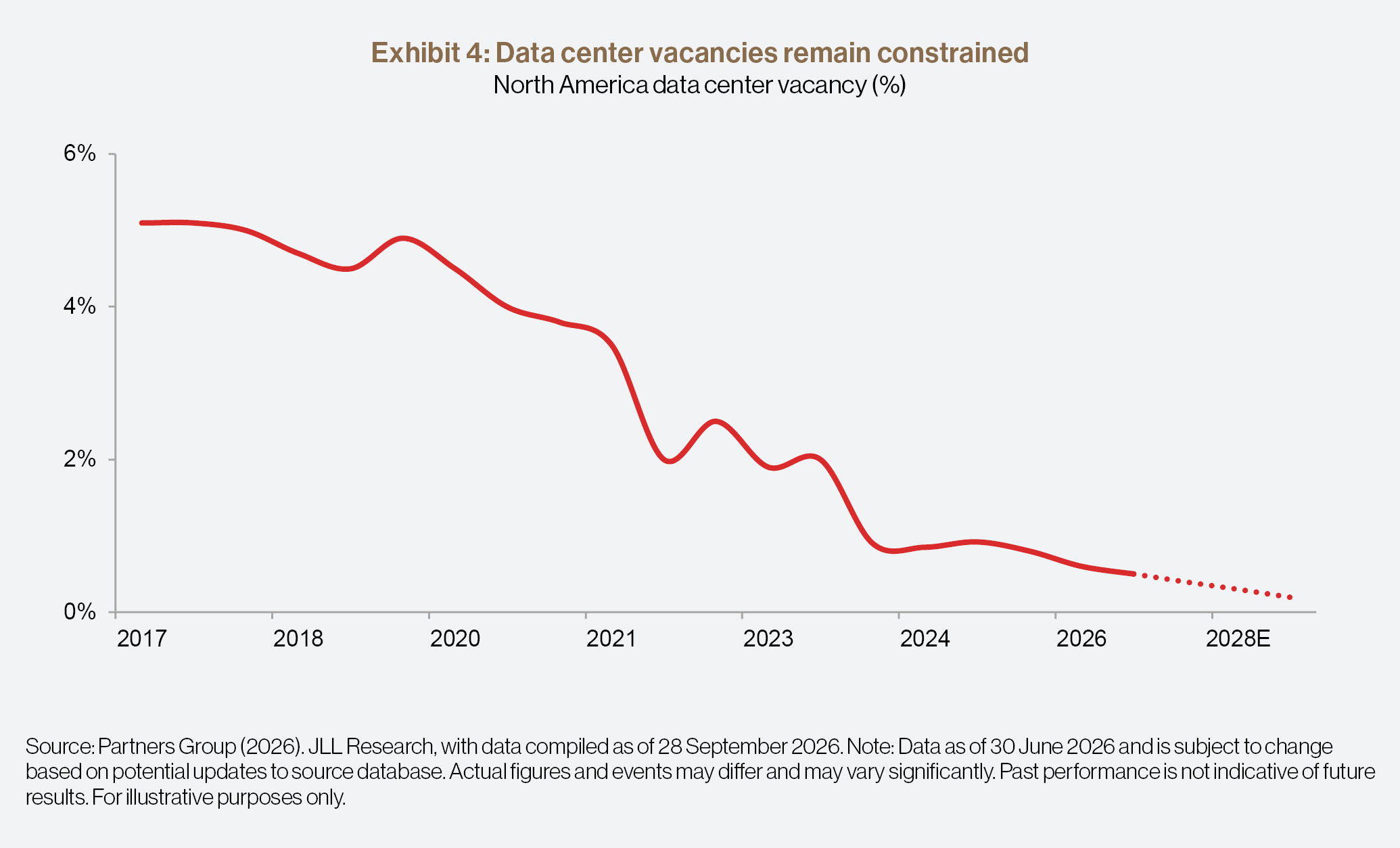
This is where the scarcity premium comes in. Data center vacancy already sits at a record-low 1.4%, while 80% of capacity under construction is preleased.10 With supply already tight, and the prospect of future additions becoming more constrained, existing powered, permitted, leased capacity – alongside projects already under construction and expected to come online in 2027 – could command a premium, particularly in markets with greater regulatory certainty.
Not a fundamental change in AI broadly, but with clear ecosystem distinctions
Interestingly, a more measured pace of development may be somewhat constructive for the broader AI ecosystem. Slower capacity additions could help temper concerns around overbuilding, give AI monetization more time to catch up with infrastructure investment and reduce the near-term financing burden across the industry – alleviating many of the concerns that dominated markets this fall. The impact across the ecosystem, however, is more nuanced and as follows:
-
Existing/pipeline data center assets with zero exposure to contested states are prime beneficiaries: Data center sites with access to power outside of Texas, Georgia, Ohio, and other affected states will become increasingly valuable – in locations like Nevada and Virginia, for example. Longer-term massive sites may be forced out of states like Texas. Data center operators with a favorable geographic footprint for existing and pipeline sites under the new regime stand to benefit.
-
Customers (hyperscalers) are well positioned: These companies' strong balance sheets, access to capital, their ability to absorb higher infrastructure costs (due to equipment sales-tax exemptions lapses) and the return on their investments that they are increasingly seeing, support our view that the hyperscalers should continue building and committing to data center capacity. However, we would expect them to turn to data center assets and jurisdictions offering greater certainty over power availability and development timelines and rely less on self-build projects in contested states.
-
Neoclouds are most exposed: They face a more challenging backdrop, particularly where contracted growth depends on capacity that has not yet been delivered. Only c. 25-30%11 of their contracted capacity is currently deployed, making them more sensitive to permitting, power and construction delays. With approximately USD 375 billion12 of contracted backlog across neoclouds, delays can push out the conversion of backlog into revenue at the same time that financing and development costs continue to accrue. Prolonged delays could threaten some neocloud business models, require more support through structured semiconductor chip deals, and trigger volatility and a broader sector repricing.
-
Chipmakers also have potential adverse exposure: Data center and power constraints increasingly represent a potential near-term risk to semiconductor demand. Delays in bringing capacity online can push out GPU deployments and potentially orders, as customers are less likely to take delivery of high-cost chips without powered capacity available to deploy them. Additionally, there is an open question of how much additional support semiconductor companies may need to provide to struggling neoclouds. These pressures also come amid growing uncertainty over the economics of AI compute. Hyperscalers' and frontier labs' laser focus on driving efficiency gains from each unit of compute may pressure future compute prices.
Bottom line
AI demand remains robust, but growing public resistance, regulatory uncertainty and technological shifts could make future data center development increasingly challenging. The result could be a slower, more selective buildout, with some projects becoming uneconomical and a growing scarcity premium for capacity with secured power, permits, and customers.