Apex Logistics - Case Study

A story of partnership, agility and growth in global logistics

1 / 5

Introduction

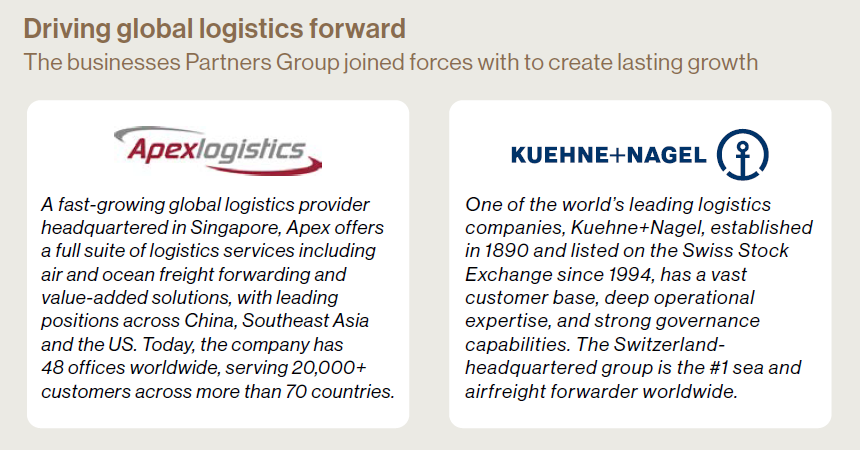
Apex Logistics was founded in 2001 with an ambitious goal: move goods across borders with outstanding agility and care. That customer-first approach soon set the company apart, and made people take notice. Its laser focus – and the growth that followed – caught the attention of two different but complementary firms: Partners Group and Kuehne+Nagel, which joined forces to acquire the company in 2021.

What happened next was not a typical tale of “merge and scale” acquisition. It left Apex’s independence intact, doubling down on its strategy and seizing the opportunities that others struggled to chase. Now, with Partners Group exiting and Apex stepping into its next chapter under Kuehne+Nagel’s stewardship, we tell the story behind this transformation: where Apex came from, how the partnership worked, and where the company plans to go next.

Before the acquisition: What made Apex stand out?

Long before any transaction discussions, Apex Logistics had carved out its own place in the logistics world. Founded in China and scaling quickly across the transpacific trade lanes, it was well on its way to becoming the key partner for companies shipping goods by airfreight between Asia and the US, whether it be semiconductors, consumer electronics, fashion and more.
While this market position was impressive, what made Apex stand out was its culture. The company was skilled at building strong customer relationships, using long-term commitments to keep goods moving in markets where geopolitical factors are often at play and delays are costly. That momentum drew attention.
 
2 / 5

A different acquisition playbook

When global logistics heavyweight Kuehne+Nagel began evaluating ways to strengthen its transpacific presence, it quickly identified Apex as a fast growing player in the market. The company was an expert in managing its aircraft assets, a capability that spoke to operational excellence.

Apex offered something the European giant did not have: a leading position in Asia for the transpacific trade lanes, with a strong base in North America. Early conversations began in 2018, with Kuehne+Nagel looking to win Apex over, and it quickly became clear that the usual M&A playbook would not apply. Traditionally, a global leader acquires a rising challenger, integrates it quietly, and eventually absorbs the brand. But with Apex, the Kuehne+Nagel team recognized that full integration would tarnish what made Apex special: its independence, its entrepreneurial spirit, and the brand name its customers trusted so much.

Instead of folding Apex into the group, Kuehne+Nagel imagined a dual-brand strategy, putting together two powerful but distinct names to double commercial opportunities and retain cultural strengths. This shift in thinking didn’t just help Kuehne+Nagel win the acquisition process when it formally began in 2020; it marked the beginning of Apex’s next phase of growth. Both companies began asking: who is the right partner to help push this forward? That’s where Partners Group came in.

The investment and strategic rationale

To unlock the potential of the acquisition, Kuehne+Nagel needed a partner that could support negotiations and build a vision for the future of Apex. These are areas where private equity aims to add value: understanding how to align interest with management teams, create value, leverage strategic acquisitions and position a company for the next chapter of development.

Partners Group was already familiar with Apex. It had been a bidder in the sale process. Way before the sale process the firm had already done the work to understand the business, the team, and its culture. It saw the same opportunities Kuehne+Nagel did. Both sides believed in a future where Apex could grow into a global logistics platform by scaling its strengths. So, in 2021, Partners Group joined Kuehne+Nagel as a minority shareholder with a focus on supporting a management incentive program, acquisition strategy, building a pipeline of targets and developing a compelling plan for long-term growth.

Partners Group took a seat on the Apex board to drive this strategy at the highest level, working in step with Apex leadership and Kuehne+Nagel representatives to build out the business case.

3 / 5

Strengthening the core

The partnership model behind the Apex acquisition was designed to protect what made the company great: its independence, market knowledge and closeness to its customers. Still, that independence came with important support.

Partners Group, taking an active seat on the board, worked closely with both Kuehne+Nagel and the Apex management to shape the company’s long-term strategy. Leveraging its experience in building businesses for long-term growth, Partners Group was instrumental in designing and implementing a robust management incentive plan that aligned leadership with ambitious growth. The firm also drove the acquisition agenda, helping to build a pipeline of acquisition targets fundamental to Apex’s next phase of expansion.

Kuehne+Nagel brought operational expertise that helped make Apex’s core strengths more scalable and durable. Beyond providing capital, Kuehne+Nagel introduced stronger cybersecurity protocols to protect against breaches, advanced technological capabilities tailored for blue-chip clients, and robust compliance support to ensure regulatory adherence.

The stewardship of Kuehne+Nagel and Partners Group was also fundamental in fostering Apex’s evolution from a China-centric logistics operator into a global, integrated freight forwarder. A cornerstone of this transformation was relocating its headquarters from China to Singapore, positioning Apex at the heart of Southeast Asia’s dynamic trade flows and enabling greater regional diversification. This move was complemented by a series of targeted expansions across Asia, including new operations in India, Taiwan, and Indonesia.

4 / 5

Creating value amid market uncertainty

Apex was already known for its agility and customer first mindset. But perhaps no event made these qualities more evident than when the world suddenly shut down. The COVID-19 pandemic brought a major shock to the logistics industry and the world economy at large.

Demand surged, with customers buying unprecedented quantities of healthcare equipment (from face masks to ventilators) and home renovation supplies (think new home offices and DIY). At the same time, passenger flights were grounded, wiping out some half of the world’s air cargo capacity.

Where others saw disruption in this supply-demand imbalance, Apex saw a moment to lead. The company had a strong history of reading the market, securing long-term capacity commitments and capitalizing on market tightening. As a result, it could upsell to existing clients, maintaining the flow of goods to customers in real need of reliability.

This ability to flex with market conditions has been at the core of Apex’s DNA. During COVID-19, the company’s agility allowed it to temporarily grow annual EBITDA fivefold – a result driven by its ability to secure capacity and respond to surging demand when others could not. While part of this spike was due to one-off earnings, it showcased Apex’s strength in capitalizing on disruption while continuing to build for the long term.

Notably, Apex once again demonstrated its agility following the US government’s “Liberation Day” tariffs announcement in 2025 – a market shock that instantly wiped out a large slice of cargo volume from China to the US. Like during the COVID-19 crisis, Apex and Kuehne+Nagel moved with speed: within days, they reallocated Apex’s airfreight capacity, reducing the number of flights out of China to the US and ramping up flights from Vietnam to the US from one to 14 per week. This decisive action allowed the companies not only to preserve business but to capture significant market share in Vietnam.

The blueprint developed in this period – rapid redeployment of assets and a readiness to seize emerging trade flows – is now being replicated in other high-growth Asian markets such as Taiwan and Thailand, especially in sectors like electronics and semiconductors.

5 / 5

The road ahead

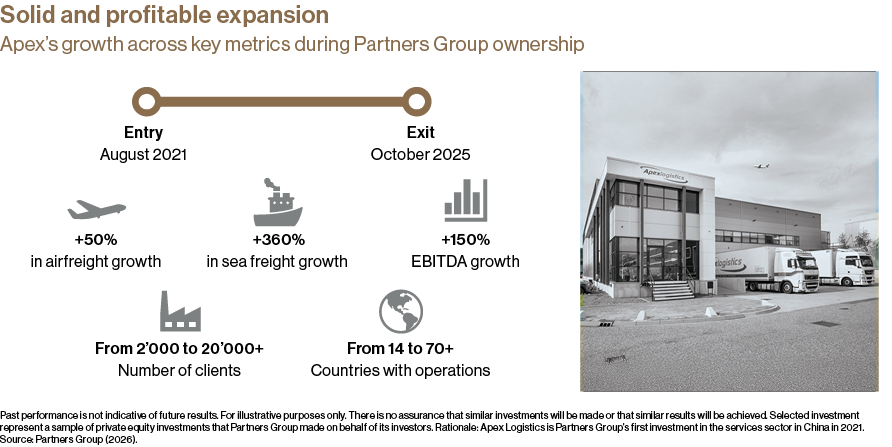
In Q3 2025, Partners Group agreed to sell its stake in Apex to Kuehne+Nagel in a transaction that valued Apex at over USD 4 billion in enterprise value. Over the course of the partnership, initiatives led by all three companies lifted Apex’s EBITDA by more than 150%, underscoring the effectiveness of their collaborative approach1.

Importantly, Apex’s long-term strategy remains unchanged. At the board level, Kuehne+Nagel and Partners Group established a path for growth. While robust organic growth has long been a characteristic of Apex, the current focus is on targeted acquisitions to extend the company’s footprint and capabilities.

Apex’s journey began with a bold vision and the power of partnership. As the company charts its next course, a new chapter awaits – one defined by new horizons and the drive to keep the world moving.

Discover more

You are leaving this website

You are about to leave this website and visit an external page.

Please note that PGPE Ltd is not responsible for the content or security of external sites.